

Why Do People Snore?
As you might encounter a partner who has quietly moved to the sofa, or maybe you are the one waking yourself up.
Snoring is probably one of the most common sleep complaints worldwide — and yet most people who snore have no idea they do it, let alone why. So what is actually happening?

What actually causes the sound?
When you fall asleep, the muscles throughout your body — including those in your throat and airway — naturally relax. For most people, this is fine. But in some people, those muscles relax a little too much.
When the muscles around the back of the throat become too lax, the airway partially narrows. As air tries to pass through this narrower space, it causes the surrounding soft tissue to vibrate. That vibration is the sound you hear as snoring. ¹
The louder the snoring, the more restricted the airflow tends to be. And at some point along that spectrum, snoring stops being just a noise issue and starts being a health one.
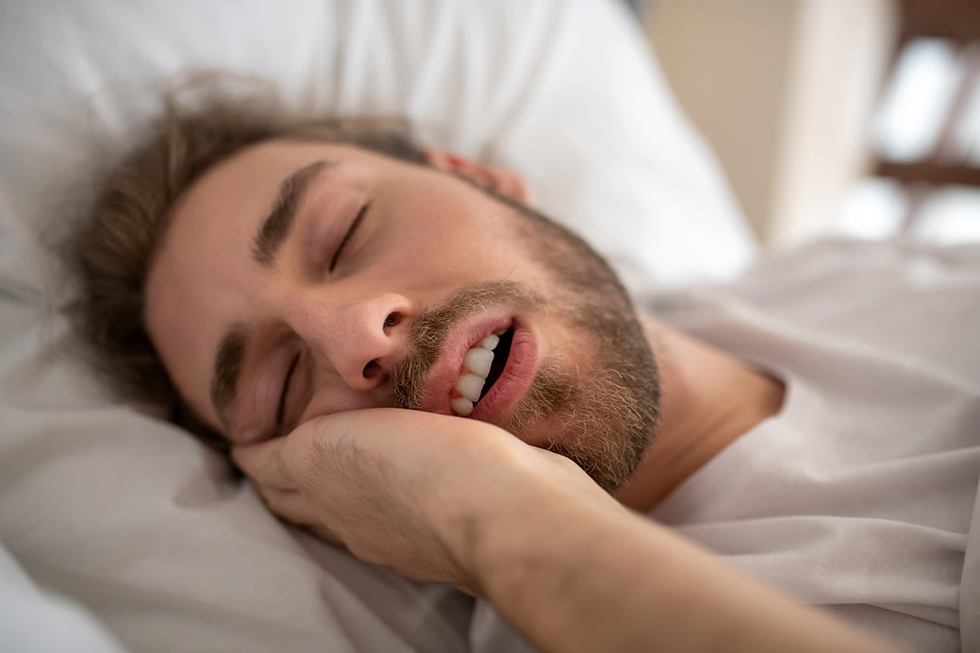
How common is snoring?
Very common. Studies suggest that around 30% of adults snore regularly — with rates even higher among middle-aged men. In one large population study, habitual snoring was found in approximately 29.5% of males and 8.9% of females, with age, obesity, and alcohol use identified as the strongest predictors. ²
Why do some people snore more than others?
There is no single cause — it usually comes down to a combination of anatomy, lifestyle, and habits.
1. Anatomy of your airway
Some people are born with an airway more prone to narrowing during sleep. Features like a narrow throat, large tongue, elongated soft palate, enlarged tonsils, or a small lower jaw all reduce the available space for airflow. ¹
2. Sleeping on your back
In this position, gravity pulls the tongue and soft palate backward toward the throat, narrowing the airway. ¹Research suggests that sleep position is a significant factor in nearly 70% of people who snore.
3. Excess weight
Extra weight — particularly around the neck — increases the soft tissue surrounding the airway, making collapse more likely during sleep. ⁴ Obesity is one of the strongest modifiable risk factors for both snoring and obstructive sleep apnea.
4. Alcohol before bed
Alcohol is a muscle relaxant. When you drink before bed, it causes the throat muscles to relax even further than they normally would — making the airway more likely to narrow and vibrate. [3] A 2020 systematic review confirmed that alcohol consumption significantly increases both the likelihood and severity of snoring. ³
5. Nasal congestion
When your nose is blocked — from allergies, a cold, or a deviated septum — you are forced to breathe through your mouth. Mouth breathing creates more turbulent airflow and is strongly associated with snoring.
6. Age
As we get older, muscle tone throughout the body — including the throat — naturally decreases. Snoring rates increase noticeably after the age of 40. ²
7. Males are more likely to snore
Men are statistically more likely to snore than women, partly due to differences in airway anatomy. After menopause, women's snoring rates increase significantly — suggesting hormonal differences also play a role. ⁷
We are organizing a small seminar to share health information about snoring in an easy-to-understand way. Healthcare professionals will also be there to debunk common myths regarding snoring and sleep apnea. If you would like to be notified about our next event, please click the WhatsApp button below to register.
*This event is for health education purposes only and does not constitute personalized medical diagnosis or treatment advice. Please do not provide medical records, test results, or other sensitive health information when registering.

When is snoring more than just snoring?
Snoring can be a warning sign of obstructive sleep apnea (OSA) — a condition where breathing actually stops repeatedly during sleep. ⁴ OSA is worth taking seriously because those breathing pauses repeatedly drop your blood oxygen levels and fragment your sleep, even if you have no conscious memory of waking. Over time, untreated OSA is associated with elevated risks of high blood pressure, heart disease, and stroke. ⁵
Signs that your snoring may be OSA:
• Witnessed pauses in breathing (your partner notices you stop momentarily)
• Waking up gasping or choking
• Feeling completely unrefreshed no matter how long you sleep
• Heavy morning headaches or very dry mouth on waking
• Significant daytime fatigue, poor memory, or difficulty concentrating
If any of these apply to you, it is worth having a proper sleep assessment. A sleep study (polysomnography) can confirm whether OSA is present and how severe it is. ⁴
Are you at risk for sleep apnea?
What can be done about snoring?
Treatment depends on the cause and severity. Common options include:
• Lifestyle changes: weight loss, reducing alcohol, sleeping on your side, and managing nasal congestion
• Mandibular advancement device (MAD): a custom dental appliance that holds the lower jaw slightly forward to open the airway — recommended by clinical guidelines for mild to moderate OSA and simple snoring ⁶
• CPAP machine: the gold standard for moderate to severe OSA — delivers pressurised air via a mask to keep the airway open all night
• Nasal devices: may help for purely nasal-driven snoring
If snoring is affecting your sleep quality or your relationship, it is worth getting a proper assessment rather than working through every pharmacy product on the shelf.
Anti-snoring device might help. Watch the video below:
Frequently Asked Questions(FAQ)
Q: Is snoring dangerous?
A: Snoring on its own — without breathing pauses — is not considered medically dangerous, though it can severely disrupt sleep. The concern arises when snoring is a symptom of OSA, which can have real cardiovascular consequences if left untreated.⁵
Q: Why do I snore on my back but not on my side?
A: When you lie on your back, gravity pulls the soft tissue of the throat toward the back of the airway, narrowing it. On your side, that tissue falls away from the airway instead.
Q: My partner says I stop breathing sometimes. Should I be worried?
A: Yes — witnessed breathing pauses are one of the key signs of OSA. Please see a doctor or sleep specialist. ⁴
Q: Can a dental device really stop snoring?
A: For many people, yes. A custom-fitted mandibular advancement device (MAD) holds the lower jaw slightly forward during sleep, which keeps the airway more open. Clinical guidelines recommend MADs as an effective first-line option for mild to moderate OSA and for simple snoring.⁶
Q: Will losing weight help?
A: For people who are overweight, yes — weight loss is one of the most effective interventions for snoring and OSA. That said, not all snorers are overweight, and not all weight loss fully resolves snoring — anatomy also plays a role.⁴
This article is produced by the Education Team of the Modern Dental Global Foundation. MDGF is a non-profit dental charity and education. This content is for informational purposes only and does not constitute individual medical or dental advice. Please consult a qualified dental professional for personal guidance.
References [1] Stuck BA, Hofauer B. The diagnosis and treatment of snoring in adults. Dtsch Arztebl Int. 2019;116(48):817–824. doi:10.3238/arztebl.2019.0817
[2] Kara CO et al. Prevalence of snoring in an adult Turkish population. Eur Arch Otorhinolaryngol. 2008;265(10):1263–1268. doi:10.1007/s00405-008-0623-y
[3] Burgos-Sanchez C et al. Impact of alcohol consumption on snoring and sleep apnea: a systematic review and meta-analysis. Otolaryngol Head Neck Surg. 2020;163(6):1078–1086. doi:10.1177/0194599820931087
[4] Peppard PE et al. Increased prevalence of sleep-disordered breathing in adults. Am J Epidemiol. 2013;177(9):1006–1014. doi:10.1093/aje/kws342
[5] Marin JM et al. Long-term cardiovascular outcomes in men with obstructive sleep apnoea-hypopnoea with or without treatment with CPAP. Lancet. 2005;365(9464):1046–1053. doi:10.1016/S0140-6736(05)71141-7
[6] Ramar K et al. Clinical practice guideline for the treatment of obstructive sleep apnea and snoring with oral appliance therapy. J Clin Sleep Med. 2015;11(7):773–827. doi:10.5664/jcsm.4858
[7] Geer JH, Hilbert J. Gender issues in obstructive sleep apnea. Yale J Biol Med. 2021;94(3):487–494. PMID:34602870

Comments